
Gilroy City Directories: What Survived
The verified Gilroy shelf is distributed across newspapers, local-history materials, regional directory holdings, and county archives. No official local page publishes a complete, continuous run of Gilroy city directories or a confirmed publisher list. The table therefore separates verified local runs from collections that require a staff check before a year or entry format is treated as local fact.
| Collection | Years | Where Held | Access |
|---|---|---|---|
| Gilroy Advocate | 1868-1922 | Gilroy Library, Digital ReeL | At home; names, addresses, notices |
| Gilroy Evening Dispatch | 1925-1943 | Gilroy Library | In-library Digital ReeL |
| Gilroy Dispatch | 1944-1999; 2001-2004 | Gilroy Library | In-library Digital ReeL; print issues |
| Santa Clara County directory matrix | 1870-1908 | San Jose Public Library California Room | Use the PDF to identify a volume, then verify Gilroy coverage |
| Gilroy yearbooks and fire-insurance maps | Exact years not listed online | Gilroy Library local history | In person; ask reference staff |
| Gilroy Museum local collection | Local history; no continuous run stated | Former Carnegie Library, 195 Fifth Street | Appointment research; copies by permission |
| County government archives | 1850s-2000s | Santa Clara County Archives | Appointment; photographs at archivist discretion |
Begin with the California Room directory holdings matrix for an older year, then ask Gilroy Library staff whether a local, county, telephone, or reverse volume is on site. A gap in a directory run is not evidence that a person left Gilroy. It may reflect an unlisted household, a missing volume, a regional edition, or a search that needs the newspaper layer.
Gilroy Directory Records Are Not All Online
Myth. An old Gilroy record is not automatically a digitized record. The California Room matrix is a finding aid, not a scanned page; the library's later newspaper runs require in-library access; the museum works by appointment; and County Archives material is viewed in its reading room. A failed web search should lead to a catalog check, reference call, or custodian request, not a conclusion that the household or collection never existed.
Gilroy Library's Historical Directory Shelf
The Gilroy Library local-history page is the best starting point for the physical and digital shelf. The branch is at 350 W. Sixth Street and reference staff can be reached at 408-842-8207. Ask for the yearbook title and year, fire-insurance-map year, and any city, county, telephone, or criss-cross directory not itemized on the web page. Current branch hours are posted at the library's location page, and local-history help is most useful during staffed hours.
The local collection combines searchable newspaper scans with physical maps and yearbooks. The library's genealogy portal gives at-home access to the Gilroy Advocate run, while the later Gilroy Evening Dispatch and Gilroy Dispatch runs are described as in-library access. Digital ReeL access is concurrency-limited, so a failed remote search can be an access-tier problem rather than proof that an issue or name is absent.
Here is the branch context for a visit to the shelf:
The official Gilroy Library location page shows the public service doorway for the branch.
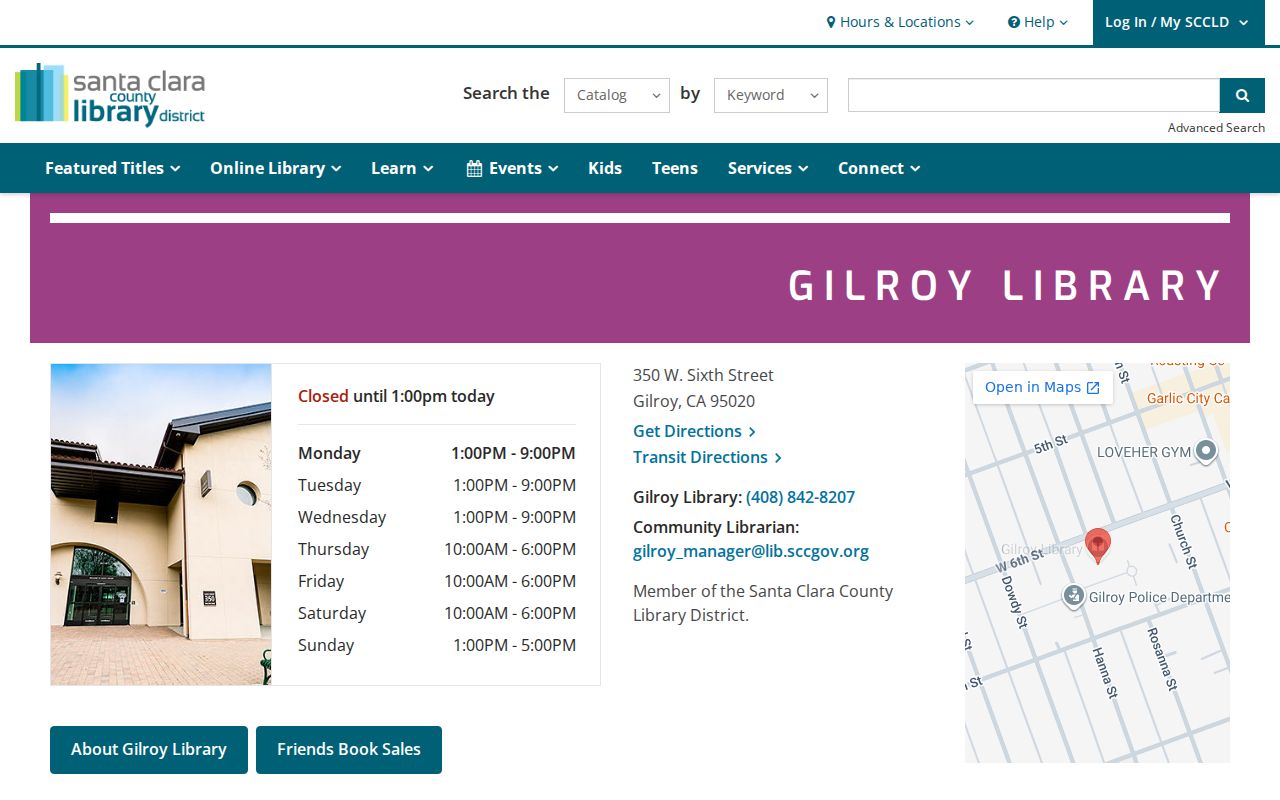
The image points to the current branch and its service information, while the historical materials themselves still need a shelf, database, or reference request. Bring a target surname, approximate address, and date range so staff can test variants efficiently.
How to Read a Gilroy City Directory
Gilroy-specific gap: no official digitized page containing a Gilroy directory entry was accessible for inspection. The publisher, printed entry syntax, spouse convention, owner or renter mark, street-index format, and abbreviation key remain unverified. The inventory below describes general directory conventions to test in the actual volume, not observed Gilroy facts.
| Name | Usually a surname with a given name or initials. Test spelling and OCR variants. |
|---|---|
| Occupation | Often a trade or institutional role; use it as a time-stamped clue. |
| Spouse | Some publishers place a spouse in parentheses or use a widow note. |
| Address | House number and street, with local suffixes and unit details to verify. |
| Owner or renter mark | Some volumes distinguish a householder from a person who resides or boards; do not assume a Gilroy code until the key is read. |
- Criss-cross directory
- A reverse arrangement that starts with a street, number, or telephone rather than a surname.
- Householder index
- A name-based list of the person the publisher chose to identify at an address. It is not a complete list of every household member.
- Abbreviation key
- The volume's guide to short marks such as residence, widow, or occupation. Photograph or transcribe it before reading entries.
Gilroy City Directory Search Tips
Insider tip. For a Spanish compound surname, search each component separately in OCR newspapers and any grantor or grantee index, then verify the date and document or page number. Try the name with and without a hyphen or space, preserve initials, and test likely OCR substitutions. A surname match becomes useful only after an address, spouse, parcel, school year, or life-event date supplies a second anchor.
Criss-Cross Pages Turn Gilroy Names Into Addresses
When an alphabetical search gives a surname but no clear household, look for a reverse or criss-cross section in the same volume. Read the street in sequence, record neighboring entries, and compare the address with a map or later directory. This method is especially useful for a family whose given name changed, a widow listed under a different convention, or a business that appears at the same storefront.
Use the California State Library city-directory guide to understand collection terminology, then use the California Room matrix to identify a regional volume dated 1870-1908. That matrix is a finding aid, not a scanned Gilroy page; the volume itself may be on site or digitally accessible depending on the item. Verify the locality list and title page before treating a San Jose-titled edition as a Gilroy city directory.
Gilroy City Directory Gaps and Newspapers
Newspapers can bridge years that a printed directory does not cover. The library reports the Gilroy Advocate from 1868-1922, the Gilroy Evening Dispatch from 1925-1943, and the Gilroy Dispatch from 1944-1999 and 2001-2004. Search notices, advertisements, obituaries, weddings, legal notices, and civic items around the directory year. An address in a notice is a lead, not a substitute for a deed or certificate.
The SCCLD Genealogy and Obituaries portal explains the newspaper access split. Use the remote Gilroy Advocate run where available, and plan an in-library session for later local issues. Ask the reference desk for a surname, address, obituary, or date search rather than assuming the public catalog indexes article text.
The library genealogy doorway is the source for the local newspaper access details.
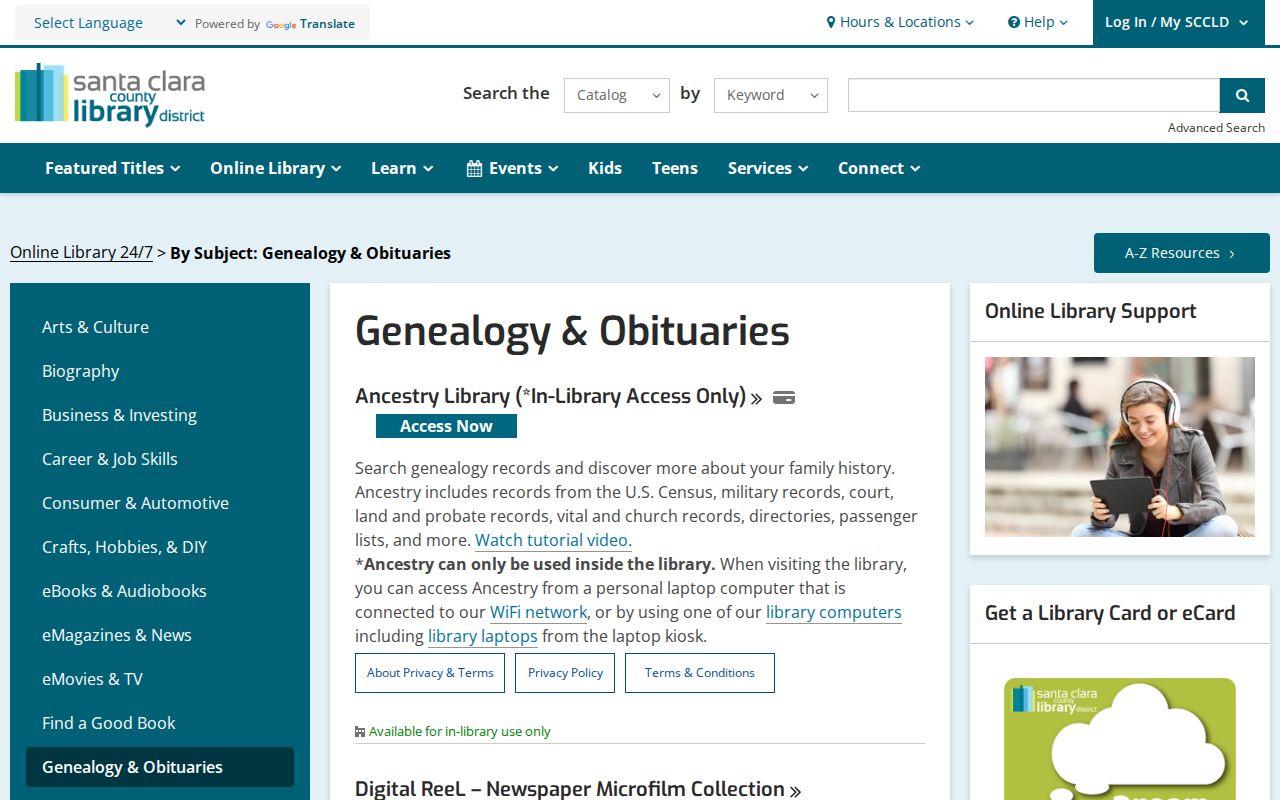
The screenshot belongs to the genealogy access channel, not a complete directory index. Pair a newspaper clue with a directory entry, census household, yearbook, or official vital index before joining two same-name people.
Trace Gilroy Households Through Directories
A household timeline works best when each directory entry is copied exactly before it is interpreted. Pair the printed year with the closest released census, then use newspapers and maps to explain the years between them.
- Choose a known surname, address, or event year. Keep initials, accents, spaces, and hyphens.
- Find the alphabetical entry and record the address, occupation, spouse note, and any mark defined by that volume.
- Flip to the criss-cross pages and read the same street before and after the target number.
- Compare the nearest federal census schedule. The 1950 census is the latest public population schedule under the 72-year rule as of 2026.
- Search the next directory or newspaper year for an arrival, move, marriage, death notice, or changed surname.
- Confirm the identity with a vital index, deed, parcel key, yearbook, or court file rather than an address alone.
The census is a household snapshot, while a directory often selects one householder or business contact. A person who disappears may have moved, died, been unlisted, or been missed by OCR. The 1890 population schedules were largely destroyed nationally, so Gilroy gaps in that period need newspaper, directory, assessment, voter, or archival substitutes. Use the NARA census research guide for released schedules; the FamilySearch California catalog may require a free account or affiliate-center access, and image restrictions vary.
Maps and Boundaries Behind a Gilroy Address
A historical address may sit in Old Gilroy, along Monterey Street or Road, near the railroad, or in a rural or rancho setting that predates today's street grid. Gilroy incorporated in 1870, while Santa Clara County records begin at statehood in 1850. A postal Gilroy label, a city-limit address, and a county-held permit can describe different boundaries.
Gilroy Library holds fire-insurance maps, but the exact sheets and years were not enumerated online. The Library of Congress Sanborn Maps collection is a discovery route, not proof that a particular Gilroy sheet is digitized. Use a map for footprint, use, lot, and street continuity, then bridge it to an APN, deed legal description, directory, or newspaper. No authoritative Gilroy street-renumbering year was verified, so do not invent one when an old number fails.
Gilroy's Library-to-Museum Records Story
Gilroy's record trail has its own institutional history. Public book service began in 1878; the Ladies Reading Circle supplied books in the 1890s; the city library was established in 1906; and a Carnegie-funded library opened at 195 Fifth Street in 1910. Gilroy joined the county system in 1968, a Rosanna Street library opened in 1975, and the present Sixth Street building opened in 2012.
Collection timeline. 1878 reading room; 1895 Ladies Reading Circle; 1906 city library; 1910 Carnegie building; 1968 county system; 1975 Rosanna Street branch; 2012 Sixth Street library.
- The Gilroy Museum grew from Armand White's local-history displays in the Carnegie Library basement in 1958.
- The city formally established the museum in 1963.
- The museum later expanded into the whole 1910 building after the library moved.
- Its more than 25,000 local and South County items may include photographs, family files, building histories, and subject folders.
Research at the Gilroy Museum is by appointment at 195 Fifth Street; call 408-846-0446. Nothing leaves the collection, and copies carry a nominal charge when permitted. This is a useful companion to a historical volume when a surname needs a photograph, building context, or family-file clue.
Gilroy City Directory Leads Need a Second Source
Separate a current city staff directory from a historical resident volume. The official Gilroy staff directory is a current municipal source organized by department, with public contact details. It can identify a city office or official, but it is not evidence that a historical household lived at an address.
Here is that distinction in the official source context:
The City of Gilroy directory page is the source for current department listings.
For older county context, use the Santa Clara County Archives by appointment at 1875 Senter Road, 408-755-7895, or archives@ceo.sccgov.org. Its collections catalog is a searchable discovery layer, while the reading room holds the material. The Archives spans the 1850s-2000s, permits photographs at the archivist's discretion, and does not issue certified copies. For a pre-1920 vital index, the Clerk-Recorder's genealogy services page directs researchers to an Archives appointment; certificate copies remain with the Recorder, and court files with Superior Court. A historical clue becomes durable only after its date, place, and person are independently matched.