
Where Gilroy Previous Residents Appear
A one-address history needs more than one kind of record. The Assessor supplies the starting parcel key, the Clerk-Recorder supplies titled transfers, and directories, census schedules, newspapers, and permits test who occupied or used the place. Coverage is uneven, so the years in this table are the verified range or the documented limitation, not a promise that every year contains an entry.
| Source | Years It Covers | Where Held | What It Shows |
|---|---|---|---|
| Assessment roll and parcel search | Current or most recently closed roll | Santa Clara County Assessor web and counter | Situs, APN, assessed value, parcel starting key |
| Recorded deeds and Official Records Index | 1850-present; index research in office | Santa Clara County Clerk-Recorder | Grantors, grantees, dates, document numbers, legal descriptions |
| Regional and local directories | 1870-1908 matrix; exact Gilroy runs not posted | San Jose California Room and Gilroy Library | Listed householders, addresses, occupations, reverse entries |
| Gilroy newspapers | 1868-1922; 1925-1943; 1944-1999 and 2001-2004 | Gilroy Library Digital ReeL | Obituaries, notices, addresses, family and civic clues |
| Federal census schedules | 1790-1950 released; 1950 latest public in 2026 | NARA and partner databases | Household members, ages, relationships, birthplace, occupation |
| Gilroy building permits | Online coverage and oldest year not verified | City EnerGov and public-records request | Work at an address, dates, applicants, contractors |
| Fire-insurance maps | Exact Gilroy sheets and years not enumerated | Gilroy Library; map catalogs | Footprints, uses, lots, street and building continuity |
| County Archives | 1850s-2000s government series | Santa Clara County Archives by appointment | County context and finding aids, not certified deed copies |
For the historical shelf itself, use the Gilroy city directories guide. For an old deed, start at the Recorder. For a household between deed dates, use a directory or newspaper and then pair it with the nearest released census. A deed owner and a listed householder may be different people, and a permit applicant may be neither.
Santa Clara Deeds Behind Gilroy Previous Residents
Santa Clara County is a major exception to the usual remote deed-index workflow. The public Official Records Index was removed from the web on November 5, 2018 under a county directive tied to protected-address redaction. Real-estate records reach 1850, but a researcher must search the grantor and grantee index at the main Clerk-Recorder office in San Jose. The official Records Search notice and the Official Records service page should be checked before travel.
The main counter is at 110 W. Tasman Drive, First Floor, San Jose; service questions go to 408-299-5688. Copies are available in person or by mail, with mail, email, and appointment channels described online. Institutional researchers can ask about the secure bulk image and index subscription, which has a nonrefundable $95 setup fee when an account is created or recreated. The remote index stopped in 2018, while office research reaches 1850, so record search names and document numbers for any later copy request.
Trace Gilroy Past Owners Backward
Walk backward from today's parcel, not from a guess about today's occupant. The Assessor web form accepts a situs address or APN, not an owner name, and tells users to enter the property address rather than a mailing address. If lawful office or request access supplies a current titled owner, use that name only as the first index key.
- Search the complete Gilroy situs at the Santa Clara County Assessor Real Property Search. Accept the terms, record the APN, and save the result or map reference.
- If the address is old, use advanced street fields, an Assessor map, or the map and characteristic order route. Keep lot, block, tract, and subdivision details.
- At the Recorder, locate the current acquisition deed by grantee, date bracket, APN, or legal description. Write down the grantee, grantor, recording date, document number, and exact description.
- Search the seller named on that deed as the earlier grantee. The seller's acquisition is the next link, not the seller's mailing address alone.
- Repeat backward, testing initials, married names, trustees, spelling variants, and the same lot or APN. Reconcile the legal description whenever a name points to another parcel.
- For older material, ask the counter for predecessor indexes, deed books, or microfilm. Order a copy in person or by mail after confirmation.
- Grantor
- The party transferring an interest, usually the seller or conveying owner.
- Grantee
- The party receiving the interest, usually the buyer or new titled owner.
- Chain of title
- The linked sequence of recorded transfers that connects one title holder to an earlier one.
- Legal description
- The tract, lot, block, map, or metes-and-bounds wording that identifies land more reliably than a changing street number.
The chain names title parties, not every resident. Pair each ownership interval with a time-specific occupant source.
A Legal Description Beats an Old Street Number
Gilroy addresses can move in meaning as the city grows. Early records may use Santa Clara County, township, rural postal, or rancho geography instead of modern city limits. The land story can also reach before county formation through Mexican land grants, including Rancho San Ysidro. A deed's legal description, an APN map, and a subdivision record can keep a house history attached to the right parcel when an old number no longer searches cleanly.
Use the County GIS SCCMap and Maps Portal to connect a situs to parcel geometry, then hand the APN to the Assessor and Recorder. GIS is not title proof, and parcel data refreshes about annually. The Assessor form offers return mail for maps and return mail, fax, or email for characteristics; verify its current printed fee before paying.
Pair Gilroy Past Residents With Census Households
Deeds tell who held title. A directory or reverse directory can identify a listed householder. The census can show the wider household, but only for a released enumeration year and the boundary used at that time. Pair the sources instead of treating one as a complete resident roll.
- Choose a directory year and copy the printed address, name, initials, spouse note, and occupation exactly.
- Open the closest public census year. Under the 72-year rule, 1950 is the newest public population schedule as of 2026; 1960 is scheduled for later release.
- Use the census geography and enumeration district, not only a modern street number. Gilroy's boundaries and rural routes may differ from the current map.
- Compare age, relationship, birthplace, occupation, and nearby household members. These details separate two people with the same surname.
- Check a directory before and after the census year, then search the matching Gilroy newspaper run for a move, marriage, death, probate, or address notice.
- Mark each result as owner, listed householder, household member, business contact, or clue.
- Criss-cross directory
- A reverse directory organized by street, number, or telephone so a known address can lead to a name.
- Enumeration district
- The census collection area used by an enumerator. Its boundary and route help locate an old household when street names changed.
Because 1890 schedules were largely destroyed, use Gilroy newspapers, the directory matrix, assessment evidence, yearbooks, lawful voter or tax substitutes, and County Archives finding aids.
Close a Gilroy Previous Residents Trail With Newspapers
The Gilroy Library's newspaper runs can turn a name into a family and address timeline: Gilroy Advocate, 1868-1922; Gilroy Evening Dispatch, 1925-1943; and Gilroy Dispatch, 1944-1999 and 2001-2004. The SCCLD genealogy portal describes at-home and in-library access. The branch is at 350 W. Sixth Street; reference is 408-842-8207. Search around a known event, not only the OCR result, because old type, Spanish compound surnames, initials, and hyphens can be misread.
Obituaries and funeral notices may supply relatives, a cemetery, a former address, or a probate date. A marriage notice can connect a maiden and married name. The notice remains a lead until checked against a vital index, certificate, deed, or court file. The County Clerk-Recorder genealogy route says birth and death holdings begin in 1873 and marriages in 1850, while pre-1920 birth and death index books are viewed by appointment through County Archives.
For probate or a certified court endpoint, use the Santa Clara Superior Court case-information route and confirm copy rules with the clerk. The Archives does not hold birth, death, marriage, divorce, building-permit, or criminal files, so its catalog is a context and finding-aid channel rather than a substitute counter.
Maps, Rural Routes, and Changing Gilroy Addresses
Historic-core research often clusters around Monterey Street or Road, Old Gilroy, Fifth and Sixth Streets, and the railroad corridor. Later growth reaches toward Santa Teresa Boulevard, the foothills, and the agricultural edge. “Gilroy” can mean the incorporated city, a USPS locality, or the wider South County community. Establish the boundary before treating an absent permit, tax record, or directory entry as meaningful.
The library reports fire-insurance maps, but exact Gilroy sheets and years were not verified online. The Library of Congress Sanborn Maps collection can locate a map record, while County GIS and Assessor maps connect a footprint to a modern APN. No authoritative Gilroy renumbering year was found, so use map, tract, lot, block, and legal-description continuity.
Gilroy's Library Story Preserved House History
Gilroy's research institutions explain why a previous-resident trail survives in more than one place. Public book service began in 1878, a Ladies Reading Circle helped supply books in 1895, and the city established a public library in 1906. The Carnegie-funded library opened at 195 Fifth Street in 1910. After later moves, Gilroy joined the county system in 1968, a Rosanna Street library opened in 1975, and the present 53,000-square-foot Sixth Street library opened in 2012.
- Armand White's local-history displays began in the Carnegie Library basement in 1958.
- The city formally established the Gilroy Museum in 1963.
- The museum expanded into the former 1910 library after the library moved.
- Its local and South County collection exceeds 25,000 items, with photographs, family files, maps, and building history among the useful leads.
When a county or local search ends, the California State Archives is a statewide discovery doorway for agency and historical series.
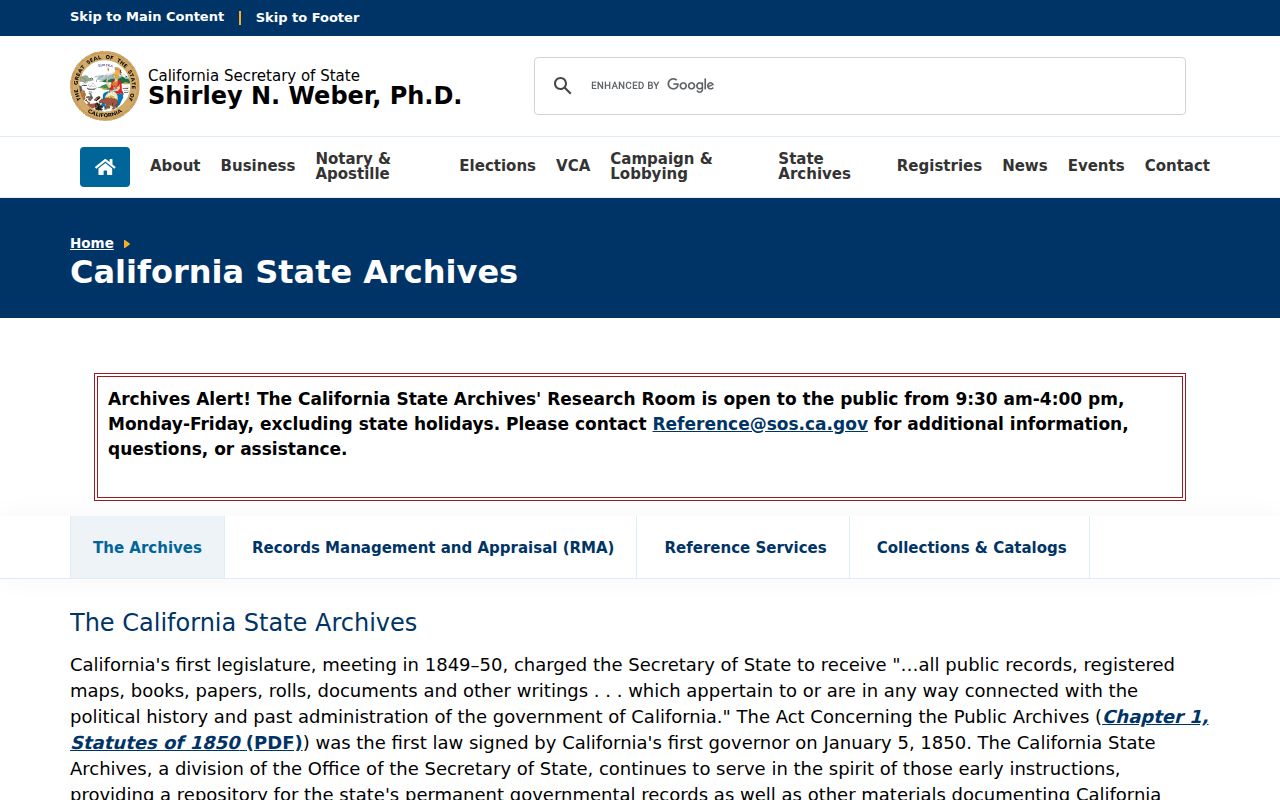
The image is a statewide archives channel, not a Gilroy address index. Use a catalog record to identify custody, then ask the holding office whether a reading-room visit, copy order, or local referral is available.
Verify a Gilroy Previous Residents Lead
Close the trail with two independent matches. A surname plus an address is a start. A surname, parcel or legal description, date, and family or life-event clue is stronger. Search Spanish compound surnames by each component, preserve OCR variants, and verify every name against the document number, census household, newspaper page, yearbook, vital index, or court record that supports it.
When a City of Gilroy permit or inspection record is needed, begin with the official EnerGov citizen portal. Its exact filters, oldest online year, and code-case visibility were not verified, so use the City's Public Records Center or public-records request channel for an identifiable existing record. Ask for an address, permit number, date range, and desired format rather than asking staff to conduct an open-ended history search.
Lawful house history. Previous-resident research is appropriate for family history, genealogy, estate and heir questions, house history, and personal curiosity. Do not use a record trail to stalk, harass, pressure, or track a living person. A Safe at Home participant, protected voter, minor, or other confidential person may not appear, and that absence must not be treated as a research failure.
Name the custodian and access route used. Clerk-Recorder copies, court files, library scans, museum material, and Archives photographs have different authority; keep those distinctions in the final notes.